



The Library of Virginia’s collaboration with Tribes began in late 2019. Choosing what to exhibit wasn’t easy.
"The spreadsheet is, um, extensive shall we say. That’s probably an understatement," says Barbara Batson, who coordinated the exhibit.
It was a journey of discovery of missing history within the library’s 130 million plus collections.
"When you look at the spreadsheet and then you think about how Virginia Indian history is taught in schools— it’s sort of: there’s Pocahontas, there’s Powhatan, there’s John Smith. Then, poof, everybody disappears," Batson says. "But what is so clear in our records is that Virginia Indians are here. They never went away. They endured a lot of pressure and persecution from the Commonwealth and white citizens. But they’ve always been in Virginia. They’ve always been vital communities. They’ve always contributed to the larger community."
Ashley Craig, the library’s outreach specialist, dove deep into the archives with tribal citizens. They found surprises.
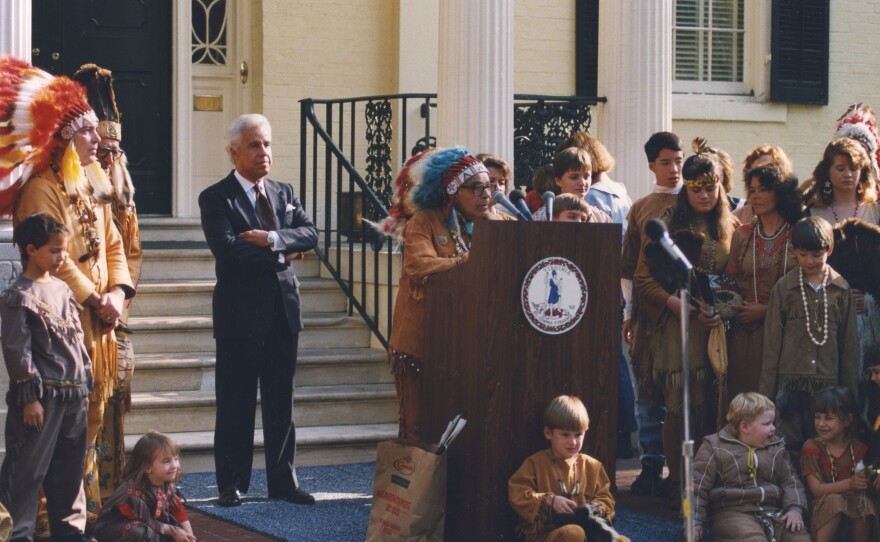
"When we first started our initial walkthroughs and talking to the different tribal leaders we pulled out images. And there’s pow wow images from the ‘20’s and one of the assistant chiefs for the Chickahominy pointed out, 'Oh, that’s not a Pamunkey person that’s a Chickahominy, and that person is Monacan.' He was pointing out all these people, all these names. And we didn’t have any names. We didn’t have the correct Tribes," Craig remembers. "We just knew what was coming from the more white perspective from the ‘20’s. So, it was very overwhelming for them to just sit here and then 'Oh, that’s my great grandfather. That’s me years later.' It was fantastic to having all those names and those people and those faces recognized for however many years it’s been in our collection."

Tribes loaned pieces to the exhibit representing their culture and history. Regalia and a drum from the Cheroenhaka Nottoway, a story quilt from the Nottoway and an eel basket from the Patawomeck.
The oldest— a frontlet— is from the Pamunkey Tribe. The medallion-like piece of jewelry worn on the forehead was given to their ancestral leader Cockacoeske by King Charles II of England as part of the 1677 Treaty of Middle Plantation.
There also are filmed interviews with tribal members centered on sovereignty, culture, identity, community, language and the future.
"It’s mainly listening to what the Tribes have to say. That really is the crux of the exhibition," Batson explains.
The library wants to continue working with the Tribes to include their perspectives in the archives. Meantime, the exhibit will begin to raise public awareness about the Tribes in Virginia.
"Most people, when you ask them how many Tribes that are in Virginia, they don’t really know. They give you about five or six or seven," Craig says. "They don’t really realize there’s a vibrant Indigenous community that is thriving here in Virginia. That is expanding and trying to better the state as well as their people."
"It’s all about stories," according to Batson. And that’s what we do here. We have stories."
The free exhibit, Indigenous Perspectives is located on the first floor of the library and runs December 5 to August 17.
This report, provided by Virginia Public Radio, was made possible with support from the Virginia Education Association.