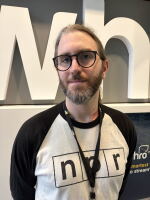
Tucked in a small building near Colley Avenue in Norfolk, Katie Culver starts the day warming up her Noritsu film developing minilab.
Culver is co-owner of Little Light Film Lab. For the last six years, it was the only remaining independent film development lab in Hampton Roads and is still the only brick-and-mortar storefront.
Culver takes a lot of care with customers’ film and helps newbies troubleshoot.
“I really value being a community asset and contributing in a way that supports local artists,” She said. “It’s something that I wish every town had access to.”
Analog photography is seeing a resurgence after decades of decline.
Filmstock sales are up more than 100% since 2020, according to Florida-based Serrano Rey Enterprises, an international seller of processing gear and minilab parts. Hundreds of labs have opened around the world in 2025, including Laboratoire Dignard, a mail-in lab in Chesapeake with dropboxes around Hampton Roads and the Outer Banks.
Photography giant Kodak went bankrupt in 2013 and reported uncertainty about its future just a year ago; it has now posted four quarters of growth, primarily because of film and chemicals.
Culver is seeing that in Norfolk, too.
“It’s thriving, honestly,” Culver said. “Usually, it would be up-and-down every few years, but ever since COVID it has not stopped. It’s reaching heights I never expected it to.”


Culver started shooting film using her grandparents’ hand-me-downs, even convincing her teacher at Sterling High School in Illinois to build a darkroom in a closet for her. Culver continued studying at the Savannah College of Art and Design in Georgia and worked in a photo lab in Honolulu before moving to Norfolk.
The field can be male-dominated, so Culver tries to encourage women photographers in the way she was in high school.
“I don’t like breaking down experiences into gender binary, but I think there is something to having a more approachable person behind the counter,” she said. “One of my favorite things about this job is seeing people’s growth in their skills. I’ll remember the first roll they dropped off, and then it’s a year and a half later, and I’m scanning their stuff, and I’ll think, ‘Oh, they’ve gotten so good.’”
When Little Light started, it averaged processing 50 rolls per month. That’s up to 50 per day.
A bulk of the growth isn’t older photogs returning to analog, either, but Gen Z and Alpha. They make up the largest section of new film customers, more than 40%, according to Serrano Rey.
“More and more folks are shooting disposable cameras at events rather than just their phones,” Culver said. “Trying to be less digital, less AI, not feeding their faces into a machine.”
Some younger photographers enjoy the more tangible nature of film photography. And unlike digital, photographers have to be more intentional with their shots.
“You have a finite number of exposures; you're at the mercy of your equipment that could malfunction, or you maybe are trying out a new camera, and you don't quite understand how the controls work,” Culver said. “But if you still nail that photo and you love it, it's just a way more satisfying feeling than firing off a bunch of extra photos on your cell phone.”
For Mike DiBari, the analog process is just relaxing. He got started when film was all there was, and still feels that the process feeds his soul.
“It's a very intimate process: Touching the film, putting the paper in the developer, watching it come up — it's very magical,” he said. “Everything is fast, instant now; this slows you down. You take one picture at a time, and then sometimes it takes days or even weeks to finish a roll.”

Many analog shooters also want to develop their rolls and make prints by hand. However, there are few spaces for people who can’t make a home darkroom to do so, especially after Norfolk’s Analogue Lab + Studio closed in early 2020.
The void became apparent for the 757 Creative ReUse Center, which got a wave of interest on social media after announcing plans to create a darkroom at its new spot on Colley.
Beth Dryer, the center’s executive director, didn’t know what she was tapping into.
“We moved here, and all of a sudden we have five different studio spaces that we can use, and one of them had plumbing in it. And I said, ‘Wouldn't it be cool if we had a darkroom,’ just kind of offhandedly.”
Not long after, photographer Bill Frank offered the center a pair of print-making enlargers. DiBari is on board to help teach photography and development and monitor the darkroom during community use. Dryer also met with the nearby Little Light Lab about getting involved.
The center ambitiously hopes to have it ready before the new year.
“Mike is already trying to figure out how we can expand the darkroom,” Dryer said.
Dryer hopes the space can give film photographers new opportunities and help keep the old-school art form going.
“I think of film photography in the same way I think about sewing or weaving,” Dryer said. “It's just very important for us to continue these traditions of making things with our hands and not just letting the machines do all the thinking for us.”


Beth Dryer is a member of WHRO’s community advisory board. The board does not make editorial decisions.